Google
Web heavenlyholidays.blogspot.com
Showing posts with label Croatia. Show all posts

Saturday, November 18, 2006

Have You Heard About Hvar Island?

Hvar Island is situated in the Adriatic Sea and belongs to Croatia. The island spreads out on 80 km from west to east and it is truly paradise for its tourists. People all over the world visit all four major parts of the Hvar Island as its surprises are many and diverse.

During its existence, the Hvar Island was know by other names also, depending on what culture it belonged to. First it was known as Pharos and after that it was called Piteyeia (around the third century B.C.) as we know from the Greek poet Apollonius of Rhodes. While it was under Roman rule it was called Pharia and later Fara. The Slavs, people that occupied the island during the middle ages, named the island Hvar. Even if the island was under Slav occupation, a lot of the inhabitants were Roman-speaking and convinced the Slaves to change the official name once more, this time into Quarra. In the eleventh century the Italians changed the name again into Lesina (meaning forest), a word full of meaning because at that time the island was perfectly characterized by a woody terrain. This name was kept until the nineteenth century when it was changed back into Hvar Island.

This place exists nowadays under the name of the Hvar Island, but the Hvar Culture has long been extinct. It is said that this culture existed from the year 3500 to 2500 B.C. The Hvar Island is an important piece in Croatian history being one of the important literary centers of this country during the Renaissance. Nowadays it is known as a producer of lavender, honey and wine and these aspects can be charming to those interested in stimulating their senses. Because of its climate and unique position, the Hvar Island is home to a lot of different species of flora and fauna like the Croatian Fighting Toad. An interesting fact about the Hvar Island is that it gets 2800 hours of sun per year. As you can see, there is no possibility for anyone to get bored on this island because it reunites history and culture for those with this kind of interests and it can be a great place to relax by bathing in the sun and admiring nature.

There are many cities to visit on this island, each with its own story and appealing characteristics. The town of Hvar had a population of little over four thousand people in 2001. It can be a tourist attraction because this is the place where the first public theatre was opened in Europe back in 1612. The town of Stari Grad located in the northern part of the Hvar Island had almost three thousand inhabitants in 2001. It is the site of some of the first human settlements on the Adriatic Sea from Antiquity. Jelsa, a town in the central northern region of the island, it’s said to have had a population of approximately 3.600 back in 2001. The fourth region that might capture your attention is the town of Sucuraj, a city of picturesque beauty situated on the east cape of the Hvar Island. Sucuraj has been named officially the center of the eastern part of the Hvar Island. The town is said to be 2300 years old, fact which can fascinate anyone. The city has been blessed with mild climate and a beautiful country side which makes it even more perfect for contemplation and relaxation. The 400 people settled here live off tourism and fishing therefore any person who is interested in this location will be received with open arms and will have a wonderful time.

The Hvar Island is thought to have been inhabited since the year 5000 B.C. Since then, a lot of different cultures living there in each age known to man have left their own fingerprint on the place. The Neolithic age proves its existence in the history of the Hvar Island by a fragment of pottery dating from the year 2500 B.C. The bronze pottery and hilltop sites represent the Bronze Age. The Iron Age left behind a lot of settlements including a castle; most of these settlements were even equipped with some rudimentary forms of defense. After that, the ancient Greeks became very interested in the Hvar Island. Remains of the Greek colony can still be seen through some of the defense walls that are still standing. After the Greeks, a lot of different cultures left their legacy to the people on the Hvar Island, like the Romans, Byzantines, Slavs, Venetians, Turks and even newer states like Austria, France, England and Russia had their own influence.

The Hvar Island is a great place for a vacation. One of the few places were you can escape from the big city life and all its problems, a place where you can really catch your breath and relax. Strolls on a forested sea path or a week of quiet life in one of the picturesque villages to see how life is without any connection to civilization. The Hvar Island is a relaxation heaven. There are a lot of sites to admire like one of the monuments of the Hvar Island, the Saint Lawrence Church which is known for the collection of paintings by old masters. The Hvar Island also has one of the largest naturist camps. There is simply no way you can get bored here.

One of the few places that man hasn’t destroyed yet, the Hvar Island is a must see just like other famous places in the world. It’s just that it hasn’t had so much publicity and this is perhaps the reason its beauty remains untouched. You can enjoy the scenery and you can see the way native people live there. This will give you an idea about the way our forefathers made a living without having to work in loud plants and polluted environments. As a fact, it is necessary to say that Hvar Island is one of the perfect places you can visit and unwire yourself.

Life in the big cities is tiring and soliciting. This is why people take vacations and search for the perfect place to forget their daily lives. One of the best places to do exactly this is Hvar island in Croatia.

Thursday, November 16, 2006

Visiting Croatia

Croatia has quickly become Europe's hottest destination, and for good reason. The rocky coastline continues for 1778 kilometres and includes pine-fringed coves, wide sandy beaches and cozy inlets. As if that weren't enough, there are a good 1185 islands that range from lush and wooded to stark and hilly. Yachties love the sailing opportunities, sunbathers have an incredible choice of beaches and scuba divers have a paradise of sea life to explore.


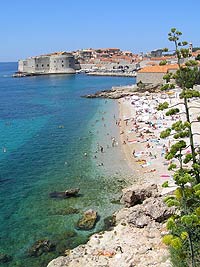
Beyond the pretty scenery, Croatia also boasts a fascinating history and cultural life.The walled city of Dubrovnik on its southern tip is a must-stop for Mediterranean cruises but the long coast is littered with remnants of Croatia's varied past.

The Romans swept through two thousand years ago, leaving an amphitheatre in Pula and Diocletian's Palace in Split. Long ruled by Venice, many ports along the coast bear the distinctive imprint of its former master. In southern Dalmatia, the towns of Hvar and Korcula resemble Little Venices without the canals. In Istria, the striking bell tower in Rovinj is modeled after that on St Mark's Square in Venice.

In contrast to the Italian-influenced coast, the Croatian interior was part of the Austro-Hungarian empire and looks it. Zagreb, Croatia's capital, has the kind of stately architecture that wouldn't be out of place in Vienna or Budapest. Plus,it has a small medieval quarter that vaguely resembles Prague.To the north of Zagreb, in the middle of green, rolling hills, lies Varazdin, Croatia's most underrated city. Lying too far from the coast to attract much tourism, Varazdin nevertheless boasts a stunningly well-preserved baroque center.

So, what to see first? Following is my personal list of highlights for a Croatian visit:

  • Dubrovnik

    Byron called it the "Pearl of the Adriatic" for the magnificent curtain of walls surrounding a city paved in marble and strewn with Renaissance sculpture.

  • Hvar Town

    In addition to the splendid harbor promenade and sculptured facades, it's becoming known for the best nightlife on the Adriatic.

  • Korcula Town

    It resembles Hvar in some ways, especially the narrow cluster of streets,but iit lies on a narrow peninsula and is quieter.

  • Rovinj

    Istria's prettiest little town, it retains the flavor of a traditional fishing port despite the heavy influx of tourists in recent years.

  • Plitvice Lakes National Park

    It has to be seen to be believed. The 16 turquose lakes seem to glow and there are waterfalls everywhere. It's a UNESCO world heritage site.

  • Brela Beach

    The idyllic coves, bordered with pine trees, stretch out like a long necklace of beaches. Forbes magazine recently named it one of the top twenty beaches in the world.

No matter where you go in Croatia, you'll find people eager to welcome tourists after the grueling war of the early 1990s. English is widely spoken and costs are comparatively reasonable compared to the rest of the European coast. So what are you waiting for?

Wednesday, November 15, 2006

Unearthly Beautiful

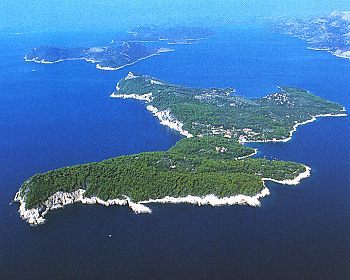
Accounts vary as to why the Roman naturalist Pliny the Elder chose to name the dainty archipelago that lies just off the coast of Dubrovnik after deer (elafos in Greek). One version has it that the assemblage reminded him of a deer’s antlers while another holds that these animals once inhabited the islands. Whatever the reason, the name has stuck, and appropriately too since they retain the beauty and mystery the Romans associated with these graceful animals.

Just three of the islands, Koločep, Lopud, and Šipan, are still inhabited, each of which can easily be reached by the inexpensive local Jadrolinija ferry that runs four times daily (twice on Sundays) throughout the year from Dubrovnik. All three islands have private accommodation, hotels, and small tourist offices that are open in summer only. Both Koločep and Lopud are, like the Old City of Dubrovnik, car-free.

A mere twenty five minutes by boat from the mainland, Koločep, the smallest of the inhabited islands at a mere 2.35 squares kilometres, was once the favored summer home of the Dubrovnik aristocracy (as if the living in Dubrovnik itself wasn’t pleasant enough!) Consequently it’s littered with all sorts of ruins, some dating back to Roman times. Much of the island is covered in thick forest with the result that the settlements of Gornje Čelo and Donje Čelo, are crammed into its two largest coves. The clear seas nearby allowed their inhabitants to develop a reputation in past centuries as the Mediterranean’s most renowned coral divers.

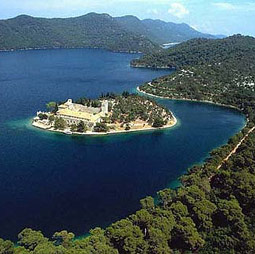
The most “developed” of the islands, although the word hardly seems appropriate, Lopud was likewise once a playground of the Dubrovnik nobility. It’s the second largest of the islands at 4.63 square kilometres and forty minutes by boat from Dubrovnik. It features the finest ruins of the three islands – in particular the remains of the Rector’s Palace (which today are preserved as a verdant park) on the outskirts of its sole town and hill-top Franciscan Monastery, whose remains offer wonderful views over the island and its many ruined churches. Lopud’s greatest pleasure is an earthly one, however, which is to be found in Sunj Bay, on the far side of the island, whose calm waters are popular with boaters and whose pleasantly sloping white-sand beach is much beloved by the small number of discerning bathers aware of its presence.

The largest (at 16.5 square kilometres) and wildest of the islands, Šipan contains a wide plain given over to wine and olive groves surrounded by hills, many of them covered in the remnants of ancient churches. There are few better ways to get a sense of how Croatia and indeed the entire Mediterranean once was than by strolling across the valley at the center of the island along road between the settlements of Suđurađ and Šipanska Luka. The two towns are 65 minutes and 100 minutes away from Dubrovnik respectively by ferry, although some ferries only stop at Suđurađ.